

Back in January, I wrote a review of Imagine: How Creativity Works by Jonah Lehrer. It was a pretty glow-y review, too. Or at least it would have been if I knew how to review books properly. I like to think I'm getting better at it, but I might just be fooling myself. Anyway, the point is that I really enjoyed that book. I enjoyed it so much that my ending recommendation was that everyone should read it. I loved it. I thought I would hold it up as one of the best (if not the best) book I read this year.
That's why I was saddened to learn that some of the quotes in the book were just plain made up. No, more than saddened. I felt betrayed. Not as betrayed as I might had I actually paid for the book, but betrayed none the less. I don't like to be lied to when I'm reading non-fiction.
His other journalistic misdeeds? Well, I'm no journalist, so I'll leave the ethics of those up to the professionals. (Also see Whose Words Are These Anyway)
I thought about taking down my review. Instead I wrote this.
Showing posts with label jonah lehrer. Show all posts
Showing posts with label jonah lehrer. Show all posts
Sep 18, 2012


Mar 31, 2012
How We Decide
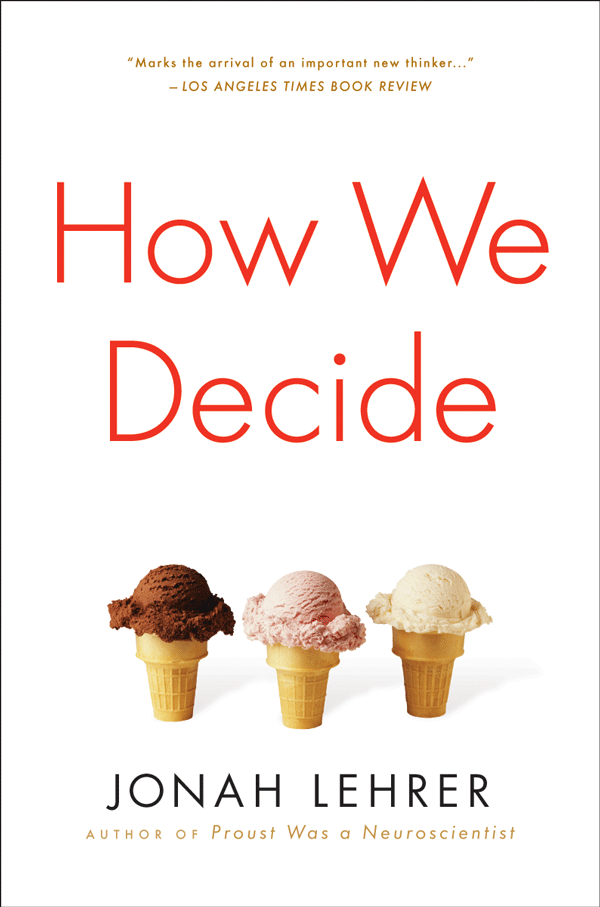

Reading Imagine: How Creativity Works made me really want to read this book. So when amazon put the kindle version on sale for 99 cents, how could I say no?
After reading the first chapter, I realised this is basically the same book, but on a different topic. It has the same tone as Imagine, the same style. The same way if presenting several types of information and bringing it back full circle, wrapping everything up in a nice little package.
That isn't to say that if you've read one, don't bother to read the other. They are two pretty different subjects. There's some overlap, but as a whole there was a ton of new information in this book. As well, I found How We Decide to be more scientific and less anecdotal than How Creativity Works.
I enjoyed this book just slightly less than the other. I don't know if it was the subject matter or the extra science, but over all I just liked Imagine better. I'm glad I read it though. I learned a lot about the human brain, neurology, psychology, autism and how air planes work. I don't know if it will help me make better decisions or not, but it can't hurt right?
On a scale from Totally Awesome to Horrifically Awful, I'd give it an Extremely Excellent. Informative and entertaining - everything a non-fiction book should be.
Jan 25, 2012
Review: Imagine: How Creativity Works
I received the book for free through Goodreads First Reads.

 is the first non-fiction book I've ever reviewed. Please forgive me if it's terrible. Also, in case it is terrible, sorry to Penguin Books Canada and Goodreads, who got together and gave me this book for free. It showed up unexpectedly in the mail one Wednesday. Unexpectedly because I don't check my e-mail enough. An awesome surprise!
Imagination and creativity can seem like elusive beasts. Mythical creatures that come into our lives as a flash, and disappear just as quickly. Is that really how it is though? There are tons of beliefs and myths surrounding creativity that actually interfere with imagination. This book explores these myths, presenting scientific studies and real life examples to show that these beliefs are just plain wrong.
This book is full of science, statistics and studies. It's full of stories about real people and companies. It's full of surprises. Whenever I picked it up, I didn't want to put it down. It was easy to read, but never boring. In short: I loved it. Even when the research it presented was surprising, I never once found myself thinking, "What? I don't quite believe that..." because everything is backed up by examples, from Bob Dylan and Shakespeare to Pixar studios and the guy who created masking tape. I learned why ideas should be shared, why you should talk to more people and that you should fail - a lot - if you want to be innovative.
This book should be read by everyone, but especially...no, just everyone.
Edit September 18 2012 - Some problems about this book have come to light. Read my brief note and some links about it here.
Subscribe to:
Posts (Atom)


